The Future as a Landscape
How Megatrends, Trends, Weak Signals, Wildcards, and Uncertainties populate the space of plausible futures

Futures & Foresight Series is a set of essays and short articles on how to use strategic foresight to build decision advantage under uncertainty—without falling into prediction. Each post focuses on practical design choices, concepts, and methods that help leaders and teams expand the space of plausible futures, challenge assumptions, and translate insights into options: strategic bets, experiments, capabilities, and roadmaps.
In earlier articles, I introduced two foundational visuals that help teams move beyond linear forecasting: the Double Cone of Futures and Joseph Voros’ Futures Cone. Those frames remain essential because they make one point unmistakable: once we leave the “comfort” of the present, we enter an expanding space of possibilities.
This article, although in a very introductory way, takes the next step.
Instead of focusing on the cone itself, we will start focus our attention on what fills it.
In Futures & Foresight, the future is not a destination to be predicted. It is an open landscape to be explored, mapped, and interpreted. And like any landscape, it is shaped by different kinds of forces: some massive and persistent, some directional but fluid, some ambiguous and emergent, some rare but consequential, and some fundamentally uncertain in how they may evolve.
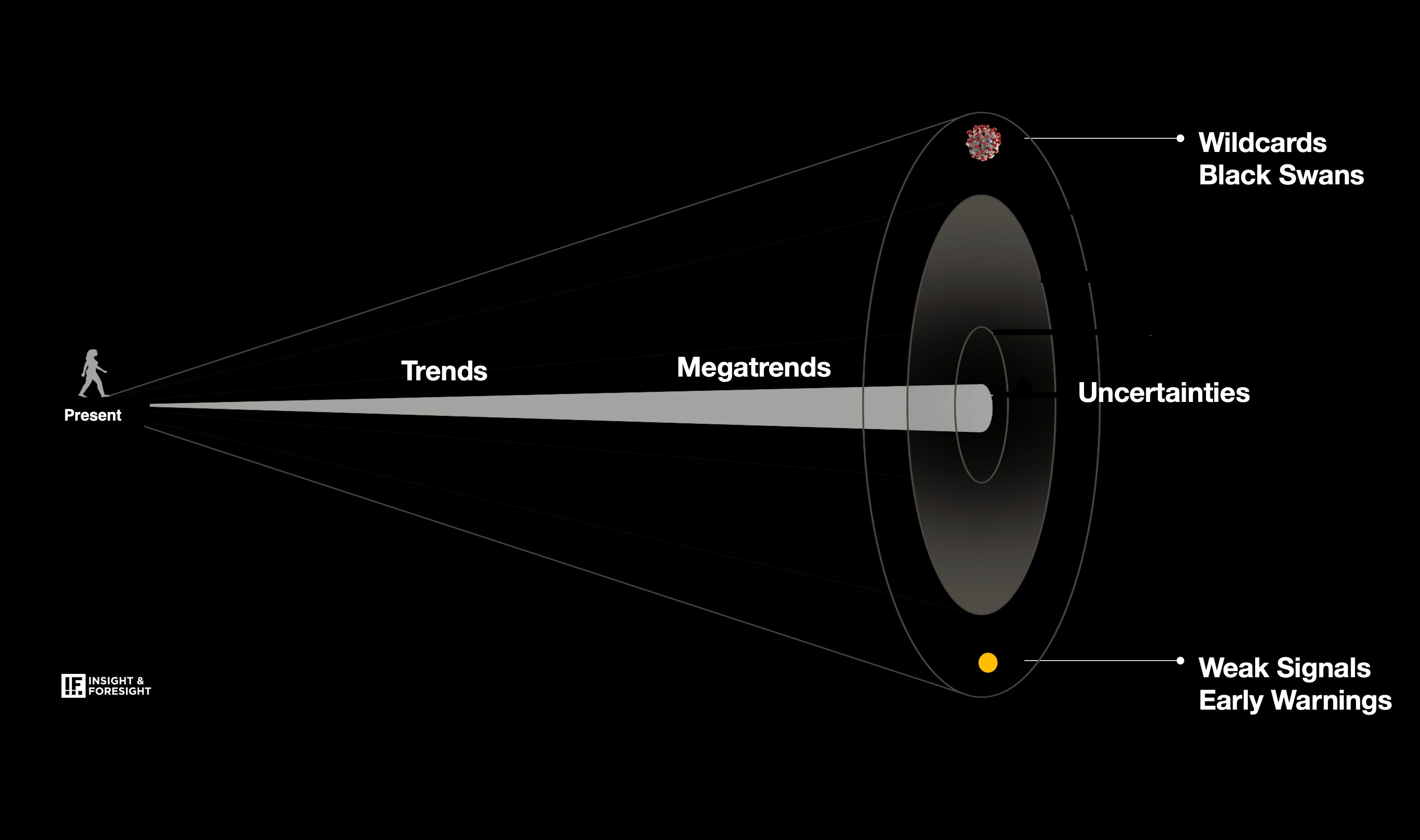
That is precisely what the Cone of Plausibility template supports: a practical way to situate and discuss different types of driving forces across time, maturity, and uncertainty.
1) Why “the future as landscape” is a useful shift
Many strategy discussions suffer from the same hidden constraint: they treat the future as a thin line—an extension of today—rather than as a wide space of alternative conditions.
The “future as landscape” metaphor changes the conversation in three ways.
From forecasting to orientation
Instead of asking “What will happen?”, we ask: What is already changing? What might emerge? What could break? What could evolve in multiple directions? The emphasis shifts from prediction to navigation.
From a single plan to portfolio logic
A landscape is explored through routes, options, contingencies, and readiness—rather than through one fixed itinerary. In strategy terms, that means building a portfolio of actions: commitments where confidence is high, experiments where uncertainty is high, and hedges where disruption would be costly.
From evidence-only to evidence plus disciplined imagination
Foresight does not abandon rigour. It broadens the types of inputs you allow into the room—while maintaining clear distinctions between what is established, what is emerging, what is uncertain, and what is disruptive.
This is why the Cone of Plausibility is more than a diagram. It is a map for sensemaking.
2) The Cone of Plausibility as a map, not a forecast
The Cone of Plausibility is a visual frame that helps teams place scanning insights across time and certainty: near-term patterns (trends), long-wave shifts (megatrends), edge signals (weak signals), and disruptive discontinuities (wildcards).
The visual logic also makes room for uncertainties—elements of the future that do not have one stable trajectory, but multiple plausible evolutions. In practice, uncertainties often become the “hinges” that allow scenario narratives to diverge meaningfully.
Seen as a landscape:
Megatrends are the geological plates: slow, massive, shaping the terrain.
Trends are the visible currents: directional movement with clearer patterns and nearer impacts.
Weak signals are faint traces at the edges: ambiguous, fragmented indicators that may amplify—or may disappear.
Wildcards / Black Swans are shocks: discontinuities that can reconfigure the landscape quickly and dramatically.
Uncertainties are branching zones: areas where the terrain could plausibly form in multiple contrasting ways.
The purpose is not to “fill the cone” for the sake of categorisation. The purpose is to build a shared map that improves strategic judgement: what to monitor, what to test, what to hedge, and what to commit to.
3) The five building blocks of the future landscape
A) Megatrends: massive forces with high inertia
What they are:
Megatrends are large-scale, long-duration shifts that originate in the past and continue to shape the future with high momentum. They tend to persist across cycles, technologies, and political changes.
How to recognise them:
Multi-decade continuity
Cross-sector and cross-geography influence
Structural drivers (demographics, climate, urbanisation, digitisation, etc.)
High inertia: difficult to stop quickly, even with strong interventions
How they function in the landscape:
Megatrends provide the “background conditions” of plausibility. They set constraints and define pressure fields. They rarely create surprise, but they often create inevitabilities that organisations under-prepare for.
A common mistake:
Treating megatrends as generic headlines rather than as forces with mechanisms and second-order effects. The practical question is not “Is this megatrend real?” but “What does it reshape, and on what timescale?”
B) Trends: directional change, more specific and more fluid
What they are:
Trends are directional patterns of change—more specific and more fluid than megatrends. They tend to have clearer evidence in the present, but their future path is still shaped by choices, feedback loops, regulation, adoption curves, and competing dynamics.
How to recognise them:
Observable pattern across multiple signals
Clear directionality (something is increasing/decreasing/shifting)
Momentum, but not necessarily permanence
Often sector- or domain-specific
How they function in the landscape:
Trends define the nearer ridgelines and valleys—the areas where strategic decisions are already being influenced. They are often the “default future” inputs that planning processes focus on.
A common mistake:
Allowing “trend” to become a label for everything. If everything is a trend, nothing is. A simple discipline is to test whether the change is persistent, directional, and evidenced.
C) Weak signals: emergent, ambiguous, fragmented indicators
What they are (and what they are not):
Weak signals are signals, not processes. They are small, early, ambiguous indications that something might be emerging. They are often fragmented, marginal, and difficult to interpret. Some will amplify into major trends; many will not.
How to recognise them:
Novelty and anomaly (“this does not fit the dominant narrative yet”)
Low maturity, low diffusion
High ambiguity (multiple plausible explanations)
Potential for amplification if conditions align
How they function in the landscape:
Weak signals sit at the edges for a reason: they stretch attention beyond what is already visible. They are especially valuable when the cost of being surprised is high.
A critical discipline:
Treat weak signals as hypotheses, not evidence of a trend. A useful standard is “indicator + alternative explanations”: what else could this mean, and what would we need to observe to increase confidence?
D) Wildcards (and Black Swans): low probability, massive impact
What they are:
Wildcards are low-probability, high-impact events that can disrupt trajectories. They are not “random brainstorming”; they are structured discontinuities used to stress-test assumptions and reveal fragilities.
Black Swans are a closely related idea, typically associated with shocks that are hard to anticipate in advance, high impact, and often rationalised after the fact as if they were predictable. In practice, teams can work with both concepts as long as the intent is clear: stress-testing strategic resilience under disruption.
How they function in the landscape:
Wildcards are the storms and earthquakes. They matter less because they are “likely” and more because they expose over-optimised strategies and hidden dependencies.
A common mistake:
Turning wildcards into entertainment. The point is not to “be creative”; it is to identify vulnerabilities, single points of failure, and assumptions that do not survive disruption.
E) Uncertainties: the branching zones that create divergent futures
What they are:
Uncertainties are driving forces whose future evolution can plausibly take multiple distinct forms. They are not just “unknowns”; they are structured unknowns that can be framed as alternative outcomes, pathways, or regimes.
Common types include:
Direction uncertainties: will a variable rise, fall, or oscillate?
Speed uncertainties: will change accelerate, plateau, or stall?
Adoption uncertainties: will diffusion be mainstream, segmented, or constrained?
Governance uncertainties: will regulation open, restrict, fragment, or harmonise?
Value uncertainties: will society prioritise efficiency, equity, security, autonomy, sustainability—or shift between them?
How they function in the landscape:
Uncertainties create forks. They enable contrasting scenarios because they allow coherent divergence. When teams say “we need scenarios,” they often mean: we need a disciplined way to work with uncertainties without falling into speculation.
4) From landscape to scenarios: how these forces become futures
A scenario is not a trend extrapolation. It is a plausible configuration of conditions.
In practical terms, scenarios emerge when you:
Anchor the terrain with megatrends (structural momentum and constraints)
Map directional movement via trends (what is already shaping decisions)
Scan the edges with weak signals (what may emerge and rewrite assumptions)
Stress-test with wildcards (what could break trajectories)
Select key uncertainties as scenario hinges (what can plausibly evolve in contrasting ways)
The result is not “the future.” It is a set of multiple, contrasting, plausible futures that expand strategic readiness.
This is where foresight becomes strategically valuable. Not because it predicts, but because it helps you rehearse multiple conditions—so you can act with greater clarity, earlier, and with fewer blind spots.
5) Why this classification discipline matters more than it seems
At first glance, these categories can look like taxonomy. In practice, they are a form of strategic hygiene.
When teams fail to distinguish between megatrends, trends, signals, uncertainties, and wildcards, they typically fall into one of two traps:
Overconfidence: treating directional patterns as certainty, and confusing momentum with inevitability.
Noise paralysis: treating fragmented signals as proof that “anything can happen,” which prevents decision-making.
The Cone of Plausibility helps avoid both traps by clarifying what kind of “thing” you are looking at—its maturity, uncertainty, and role in shaping plausible futures.
It also improves the quality of dialogue across stakeholders. People can disagree—productively—because they are disagreeing at the right level: mechanism, evidence, trajectory, impact, and conditions for amplification.
Closing: mapping the landscape is the beginning, not the end
If you only take one idea from this article, let it be this:
Foresight is not “thinking about the future.” It is building a shared map of a landscape that contains multiple driving forces and can present multiple plausible futures—then deciding how you will navigate it.
Megatrends, trends, weak signals, wildcards, and uncertainties are not abstract categories. They are the terrain features of the future landscape. Once you can see them clearly—and keep them distinct—you can build scenarios that stretch perception, stress-test plans, identify options, and make better strategic decisions under uncertainty—without falling into prediction.
How to use this Template in a Workshop
To use the Cone of Plausibility in a workshop (45–90 minutes), run a simple, disciplined flow: define the focus and time horizon (e.g., 5/10/15 years); map the most evident Megatrends and Trends along the centre line; add Weak Signals at the edges (low maturity, high ambiguity); introduce a small number of Wildcards / Black Swans in the far, high-uncertainty zone; do an implications pass for each item (“what does this enable or undermine?”); and close with a strategic response that forces decisions—what you will monitor, experiment with, hedge, or commit to—so the session ends with a practical portfolio rather than “interesting insights.”
Throughout, elevate the quality of discussion with prompts that keep categories distinct and decisions grounded (e.g., “which forces are shaping decisions today?”, “which shifts will persist across cycles?”, “what small anomaly might matter later?”, “what could break assumptions?”), and make uncertainties explicit by asking which forces could evolve in two or three distinct directions and what each direction would imply.
Common pitfalls to avoid are predictable but costly: treating everything as a trend (test for persistence, directionality, and evidence), treating weak signals as predictions (require an indicator plus alternative explanations), and ending without decisions (force a short portfolio of commitments, experiments, and monitors).
For full facilitation guidance—step-by-step instructions, prompts, and practitioner notes—this template sits within Futures.360, alongside 29 templates designed to make strategic foresight & innovation practice repeatable and actionable across contexts.
Learn more about Futures and Foresight
Explore the Strategic Foresight Masterclass Series - 4th edition
https://www.ifforesight.com/learning/strategic-foresight-masterclass
Nice work Paulo.
How to apply these useful categories and factors in real-world situations is what we need most.